
Who Gets a Stone
Dead Body Politics at Home

I have been throwing around the phrase “dead body politics” in these posts for a while now, mostly as a way to explain what I keep witnessing in Namibia. The argument, borrowed from scholars like Thomas Laqueur and Katherine Verdery, is that the dead do not stay politically neutral. How a society treats its dead, where bodies are buried, whether they are named, who controls their remains, how they are commemorated or quietly erased, all of it shapes the power structures and identities of the living. The dead make claims. They orient communities. They legitimize or delegitimize authority in the present.
In earlier posts, I have used this framework to think through the sacred fire, Red Flag Day in Okahandja, the fight over repatriating OvaHerero skulls still held in German museums, and the work of people like Laidlaw Peringanda, who goes out to the mass graves on the outskirts of Swakopmund several times a year with a shovel to cover the exposed remains of genocide victims back over with sand. In Namibia, the connection between the dead and power is visible, deliberate, and openly felt. People do not need a theory to explain why that work matters. They already know.
What I want to sit with in this post is something I have been slower to say directly. Dead body politics is not a Namibian phenomenon I have imported as an exotic theoretical lens. It is the operating logic of commemorative space everywhere. Including here.
In Swakopmund, a city still marked by the architecture, street names, and monuments of the German colonial period, the question of whose dead get to matter plays out in concrete and ongoing ways. The mass graves of OvaHerero and Nama victims sit unmarked on the city’s outskirts while a monument honoring the colonial soldiers who oversaw the genocide stands on the grounds of the State House, protected as national heritage. Laidlaw has spent years organizing cemetery cleanings, running genocide tours past that monument, building the only dedicated genocide museum in Namibia on his own property in the township of Matutura, and advocating for the renaming of streets and the removal of colonial statues still embedded in the city’s public identity. The resistance he has faced from the municipality, from some segments of the community, from institutional indifference, is its own kind of answer to the question of whose past is considered worth protecting.
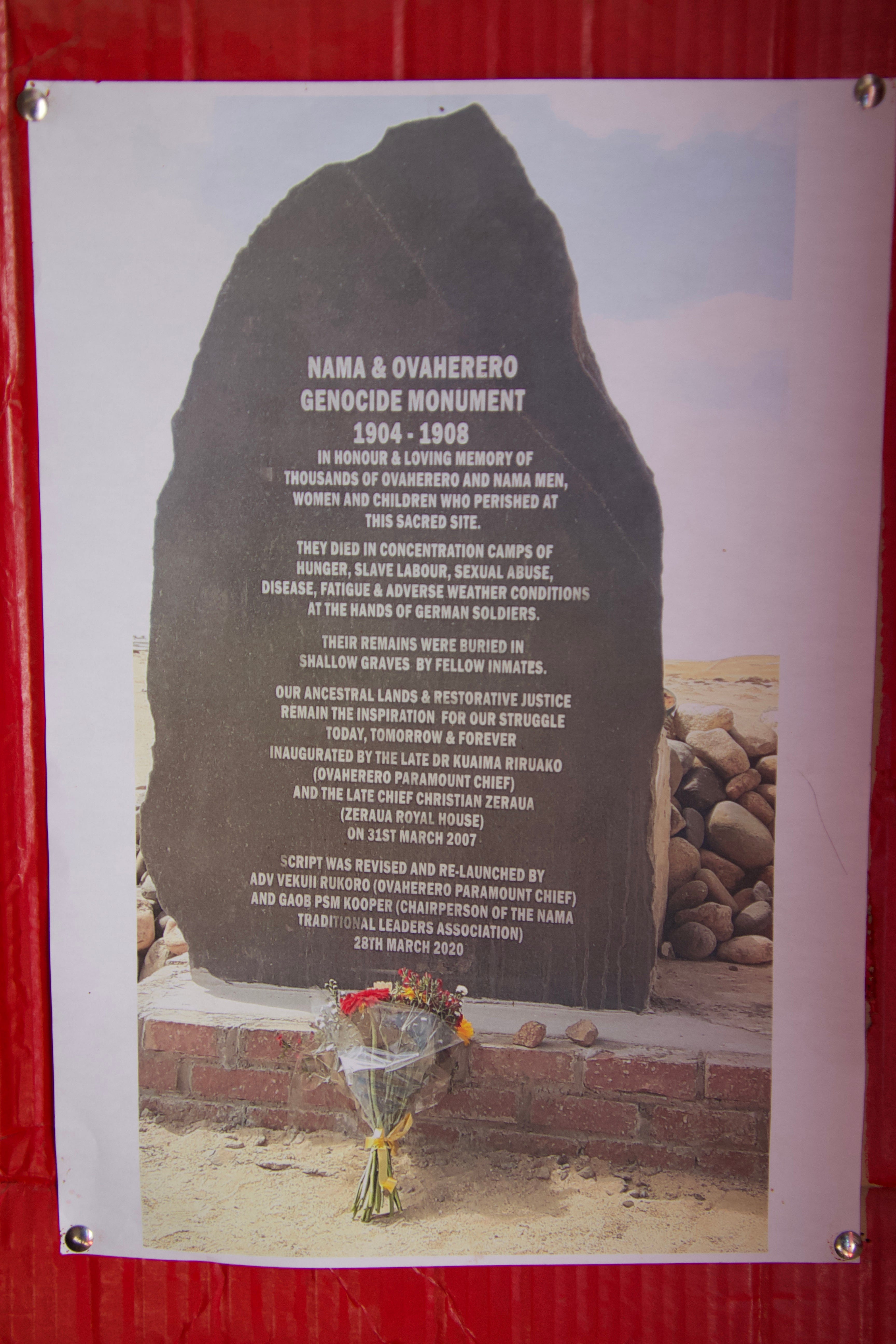
The commemorative stones at Swakopmund have, over time, been re-inscribed to include the word genocide. I wrote in an earlier post about what that act means. It is not merely a historical correction. It makes a claim the present has to respond to. Words on stones do political work. So does a can of red paint. A few years ago, unknown activists threw red paint on the Marine Denkmal. The traces are still visible. The statue is still standing.
These are not dynamics unique to Namibia, and I think the moment calls for saying that plainly.
Across the United States right now, communities are engaged in active disputes over commemorative space: over which names belong on public buildings, which figures deserve monuments in town squares, which bodies of water carry names worth keeping, and which historical markers at national sites accurately represent what happened at those places and to whom. At Little Bighorn in Montana, the Northern Cheyenne and Lakota histories and communities have found themselves at the center of one such dispute, centered on whether the story told at that battlefield will include the full weight of what federal policy did to Indigenous peoples in the generations that followed it.
What is at stake at Little Bighorn is not factual disagreement. The history is documented. What is at stake is whether that history will be allowed to make a claim on the present, whether the dead will be permitted to remain present in the public reckoning of that place. The Northern Cheyenne have been clear about what removing that presence means to them. It does not settle history. It reopens a wound. And the people most committed to keeping those markers in place are, not coincidentally, the same people who have spent generations doing the work of ensuring their ancestors are not forgotten.
That is Laidlaw with his shovel. Different geography, different century, same refusal.
Dead body politics, then, is not a framework I reach for because it sounds sophisticated in a university classroom. I reach for it because it keeps describing reality accurately, in Namibia and now visibly at home. The question being decided at a gravesite in Swakopmund and at a national monument in Montana is the same question. Not what happened. The evidence for what happened keeps surfacing, literally, from the sand at Swakopmund. The question is whether what happened will be allowed to make a claim on who we are today and what we owe to the people who lived it.
Commemorative space is never neutral. A marked grave is an assertion. A renamed street is an reclamation. A plaque, a monument, a museum built on someone’s own property because no institution would support it, all of these are arguments. And the resistance to them is an reclamation as well, made in the same language, about the same question.
Who gets to be present here. Who gets a stone. Who does the work when the institutions will not.
The bones keep surfacing. Somebody keeps putting them back, literally and figuratively. Both having real consequences for how we write and relate to history.
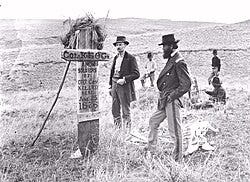
Taken by photographer Stanley J. Morrow in 1879 during U.S. Army re-burial visit to the Custer battlefield. The expedition was led by Captain George K. Sanderson, seen here in the foreground looking at the recently erected monument to Myles Keogh and the fallen members of Company I, 7th US Cavalry. Public Domain Source

More on the Little Big Horn case and others here:
https://www.outsideonline.com/outdoor-adventure/environment/removed-national-park-service-signs/